At the Consumer Electronics Show in Las Vegas, several robotics companies showcased humanoid robots attempting complex household activities, revealing persistent challenges in dexterity and adaptive learning. Despite significant technological investments, the demonstrations highlighted the substantial gap between current robotic capabilities and the fluid, intuitive movements humans perform effortlessly in domestic environments.
The Rise of Humanoid Robots at CES 2026
The Consumer Electronics Show in Las Vegas has become a pivotal showcase for the next generation of robotic technology. Humanoid robots are emerging as a transformative force, demonstrating capabilities that range from performing household chores to interacting with humans in increasingly sophisticated ways. Companies like LG Electronics are pushing the boundaries of what mechanical assistants can accomplish.
These human-inspired machines are designed to navigate environments using similar tools and techniques as humans, with the ultimate goal of increasing efficiency. While current iterations are still limited, they represent a significant leap forward in artificial intelligence and robotics. The ability to perform tasks like loading laundry, pouring coffee, and even playing ping pong signals a potential paradigm shift in human-machine interaction.
The technological landscape is rapidly evolving, with major players investing heavily in developing more adaptable and intelligent robotic systems. Innovations in fine motor control, vision-based technology, and artificial intelligence are making these robots more nimble and capable of handling complex, multi-step tasks.
LG’s CLOiD: A Glimpse into Domestic Automation
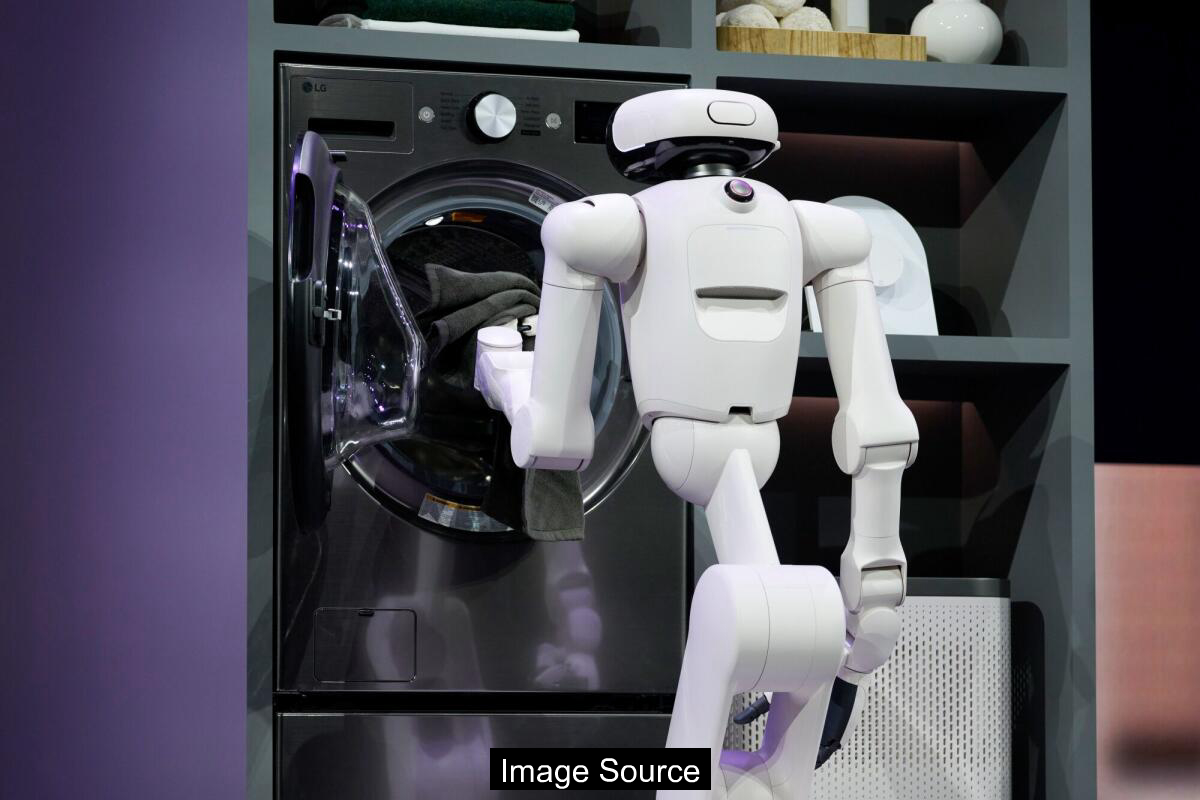
At CES 2026, LG Electronics introduced CLOiD, a concept robot standing slightly under five feet tall with a digital display for eyes. The robot’s live demonstration represented a bold step in showcasing potential home automation technologies. By slowly loading a piece of clothing into a washing machine, CLOiD embodied LG’s vision of ‘ambient care’ — machines quietly assisting in daily life.
The robot’s design reflects a broader strategy of seamless integration into domestic environments. LG executive Brandt Varner described the goal as creating a ‘zero-labor home’ that saves time and enhances comfort. This approach differs from previous robotic demonstrations by focusing on mundane, repetitive tasks rather than spectacular performances.
CLOiD is part of a growing trend of task-focused robots, similar to SwitchBot’s Onero H1. These machines aim to address specific household needs, suggesting a pragmatic approach to home robotics that prioritizes utility over complexity.
Robotics Beyond the Home: Industry Applications
While home applications generate excitement, many robotics companies are focusing on industrial and commercial sectors. Businesses like Artly Coffee and VenHub Global are developing AI-powered robotic cafés and convenience stores, demonstrating the technology’s versatility. Manufacturers and logistics companies see significant potential in automated systems that can perform repetitive tasks with high precision.
Qualcomm is positioning itself as a critical infrastructure provider, showcasing processors and software capable of powering both household robots and full-size humanoids. Boston Dynamics and Hyundai are collaborating on advanced robotic systems, with testing underway for next-generation humanoid robots in manufacturing settings.
The industrial sector offers more predictable environments for robotic deployment, making it an ideal testing ground for emerging technologies. Controlled settings like factories allow for more straightforward implementation compared to the complex, unpredictable nature of home environments.
Challenges and Limitations
Despite impressive demonstrations, significant obstacles remain in widespread robotic adoption. Fine motor control, particularly involving complex manipulations, has historically been a major challenge. Home environments present additional complications, including unpredictability and potential clutter that can confuse robotic systems.
Cost remains a substantial barrier, with current humanoid robots potentially costing tens of thousands of dollars. The economic justification for such expensive machines performing simple tasks like laundry is questionable. More compelling use cases might emerge in specialized settings like hospitals, where robots could handle large-scale repetitive work.
Experts like Bill Ray from Gartner suggest that near-term robotics will likely focus on specific, targeted applications rather than attempting comprehensive human-like functionality. The ability to autonomously interpret and respond to complex scenarios remains a significant technological hurdle.
Frequently Asked Questions about Humanoid Robots
Robotics experts and technology enthusiasts often have questions about the current state and future potential of humanoid robots. This section addresses two common inquiries to provide clarity on this emerging technological frontier.
Q1. How close are humanoid robots to becoming mainstream household assistants?
A1. While significant progress has been made, widespread home adoption is still years away. Current robots are limited in adaptability and remain prohibitively expensive for average consumers.
Q2. What are the most promising applications for humanoid robots?
A2. Industrial settings like manufacturing, logistics, and specialized service environments (hospitals, warehouses) currently offer the most promising and practical deployment opportunities.
Future Outlook
The trajectory of humanoid robotics suggests a future of incremental but potentially transformative advancements. As artificial intelligence, sensor technologies, and mechanical design continue to improve, these machines will become increasingly sophisticated and capable.
Investment in robotics continues to accelerate, with major technology companies and startups alike recognizing the immense potential of physical AI. The next decade will likely see dramatic improvements in robot mobility, task complexity, and human-machine interaction.
While complete household automation remains a distant goal, the steady progress in robotics promises exciting developments. The key will be balancing technological innovation with practical utility, ensuring that these advanced machines genuinely improve human life.
※ This article summarizes publicly available reporting and is provided for general information only. It is not legal, medical, or investment advice. Please consult a qualified professional for decisions.